Uméboshi

Jun 22, 2019 | Kitchen Culture, Summer, Year-Round

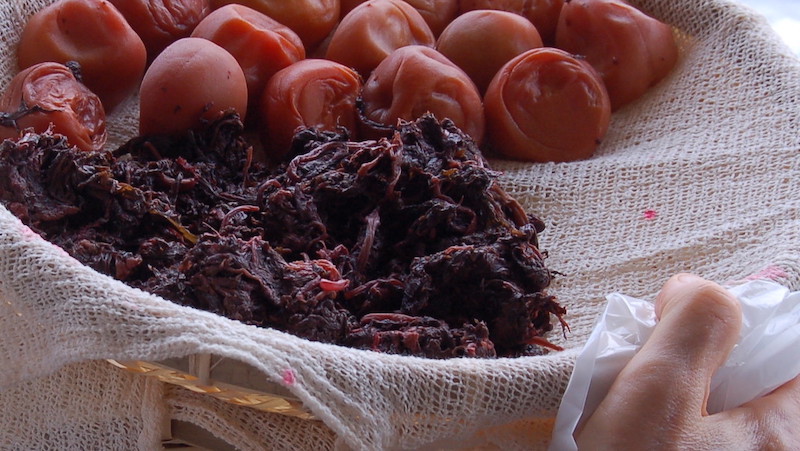
Uméboshi 梅干し and aka-jiso leaves

After many weeks of bathing submerged in salty-sour, rosy-colored umézu this year’s plums are ready to be air-dried… the final stage of plum work (umé shigoto). What’s needed is a string of dry days, what’s known as umé no doyō-boshi 梅の土用干し. The plums and aka-jiso leaves are lifted from their umézu bath first thing in the morning and set out to dry.

I line several bamboo trays with coarsely woven linen cloth to insure good ventilation. At sundown the plums and leaves are returned to their umézu only to be lifted the following morning from their bath and aired again.

This dip-bathing at night and air-drying during the day is repeated for at least 3 consecutive days.
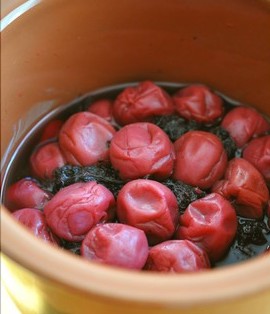
 

Between days of air-drying, the plums are returned to their rosy-colored aka-jiso tinted umézu bath.


DOWNLOAD reference sheet with instructions/recipe
Flowchart for making umeboshi

Oysters

Oysters

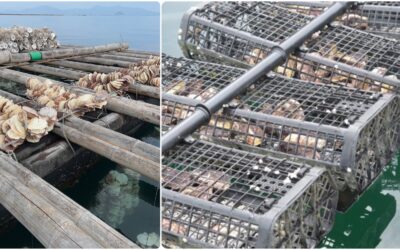
Throughout the world, oysters have been a popular food source since ancient times. Archeologic evidence in Japan, in the form of kaizuka (shell mounds), dates to the Jōmon period (14,000-300 BCE). Oysters had been abundant for millennia and harvested in their natural...

Kagami Mochi

Kagami Mochi

At New Years’ time, the Japanese decorate their homes with a special display called KAGAMI MOCHI. There are many regional variations on the theme but typically two large rounds of omochi rice taffy are stacked with a daidai 橙 (bitter orange) on top. The arrangement is...

Symbolic Pine

Symbolic Pine

Because pine trees are hardy evergreens, they are a symbol of longevity and resilience in Japanese culture. As such they are a key motif used at New Year’s. Various foods are configured to evoke the image of pine needles (matsuba 松葉 ) and pine cones (matsukasa 松笠 )....

Katsura Muki, gossamer thin peels

Katsura Muki, gossamer thin peels

Daikon radish is peeled into long, seemingly impossibly thin ribbons in a cut known as katsura muki. The skill needed to produce these peels is the most basic requirement in any Japanese professional kitchen. It typically takes months (if not years) of daily practice...

Recent Posts & Projects