
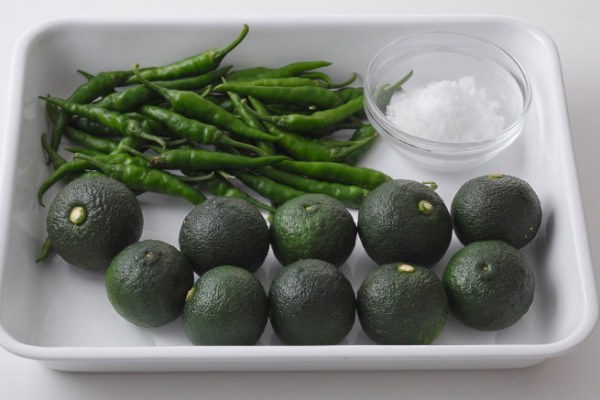
Yuzu Koshō

Sep 25, 2020 | Autumn, Kitchen Culture, Tools & Techniques

Yuzu Koshō

柚子胡椒

Mid-September…the heat of summer lingers on, but there is the promise of cooler autumn days ahead. That is when I typically see baskets of green yuzu in my Tokyo neighborhood markets and bags of green chili peppers, too. Within a month the yuzu will begin to ripen to yellow and the peppers to red, but while both are still green is the perfect time to make a spicy condiment known as yuzu koshō.

On hot days I’ll put a dab on hiya yakko tōfu or cold-poached fish or chicken. On cooler evenings, I’ll mix a bit with vinegar and soy sauce to use as a dip for nabemono hot-pots.
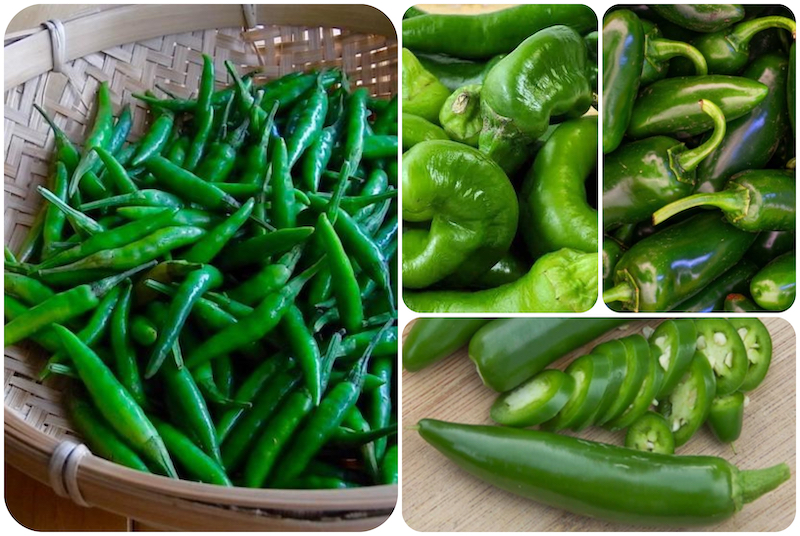
From left, clockwise: Aotōgarashi 青唐辛子, Shishitō 獅子唐, Jalapeño  ハラペーニョ, Serranoセラーノ

SHU (the Scoville Heat Unit) is used to measure degree of spiciness of foods by determining the concentration of capsaicinoids, chemical compounds responsible for the tingling sensation of heat when eating foods such as chili peppers. Compared to Korean, Thai, Chinese, Mexican and many other cuisines, most of Japan’s chili peppers are relatively mild  — less than 1,000 SHU (compare to Serrano chilis considered to be of medium heat that measure 10,000 to 23,000 SHU).

The Japanese refer to extremely spicy foods as GEKI KARA 激辛. For this yuzu koshō recipe you decide how high you want to crank the heat by choosing the variety of capsicum: slender ao tō is the classic choice but chubby shishitō will be pleasantly tingly and very aromatic.

DOWNLOAD recipe for Yuzu Koshō

Osozai Side Dishes

Osozai Side Dishes

Modern households everywhere are challenged with balancing a desire to eat healthfully with limited time to prepare meals. In Japan, the food industry’s response has been to offer a vast assortment of prepared foods for sale through various outlets: convenience...

Using Food Fully

Using Food Fully

Meals planned around a single ingredient prepared in many ways are referred to as tsukushi (or zukushi) 尽くし menus. The verb tsukusu means "to use, or consume, entirely." This no-waste approach is both a frugal and practical way to cook, making the most of what is...

The Language of Learning

The Language of Learning

Although we are all born with some innate capabilities, we also must LEARN in order to survive and thrive. Different cultures manage learning differently. The Japanese language has two verbs that can be used when talking about acquiring information and experience....

Oysters

Oysters

Throughout the world, oysters have been a popular food source since ancient times. Archeologic evidence in Japan, in the form of kaizuka (shell mounds), dates to the Jōmon period (14,000-300 BCE). Oysters had been abundant for millennia and harvested in their natural...

Recent Posts & Projects