PROJECT Adzuki: Sweet & Savory

Nov 11, 2022 | Kitchen PROJECTS, Year-Round

PROJECT Adzuki: Sweet & Savory

The adzuki bean 小豆 plays a prominent role in Japanese cookery, especially in the making of sweets… though savory dishes also abound. This Kitchen PROJECT is about  exploring the many possibilities.

I provide one sweet recipe for TSUBU AN (chunky red bean jam) and one savory recipe for SEKIHAN (festive red rice and beans) to get you started. Further suggestions below in the captions to the images.

Hope you’ll try making one or more dishes with ADZUKI beans.

The SWEET SIDE of ADZUKI

Pictured above from top left, clockwise: DORA YAKI pancakes with tsubu an filling. GRIDDLE CAKES topped with tsubu an and ice cream (kuro mitsu black sugar syrup in the small pitcher), tsubu an topping for SOFT SERVE ice cream, OGURA TOAST, a specialty of Nagoya where thick white bread is toasted and slathered with tsubu an and topped with a pat of butter.
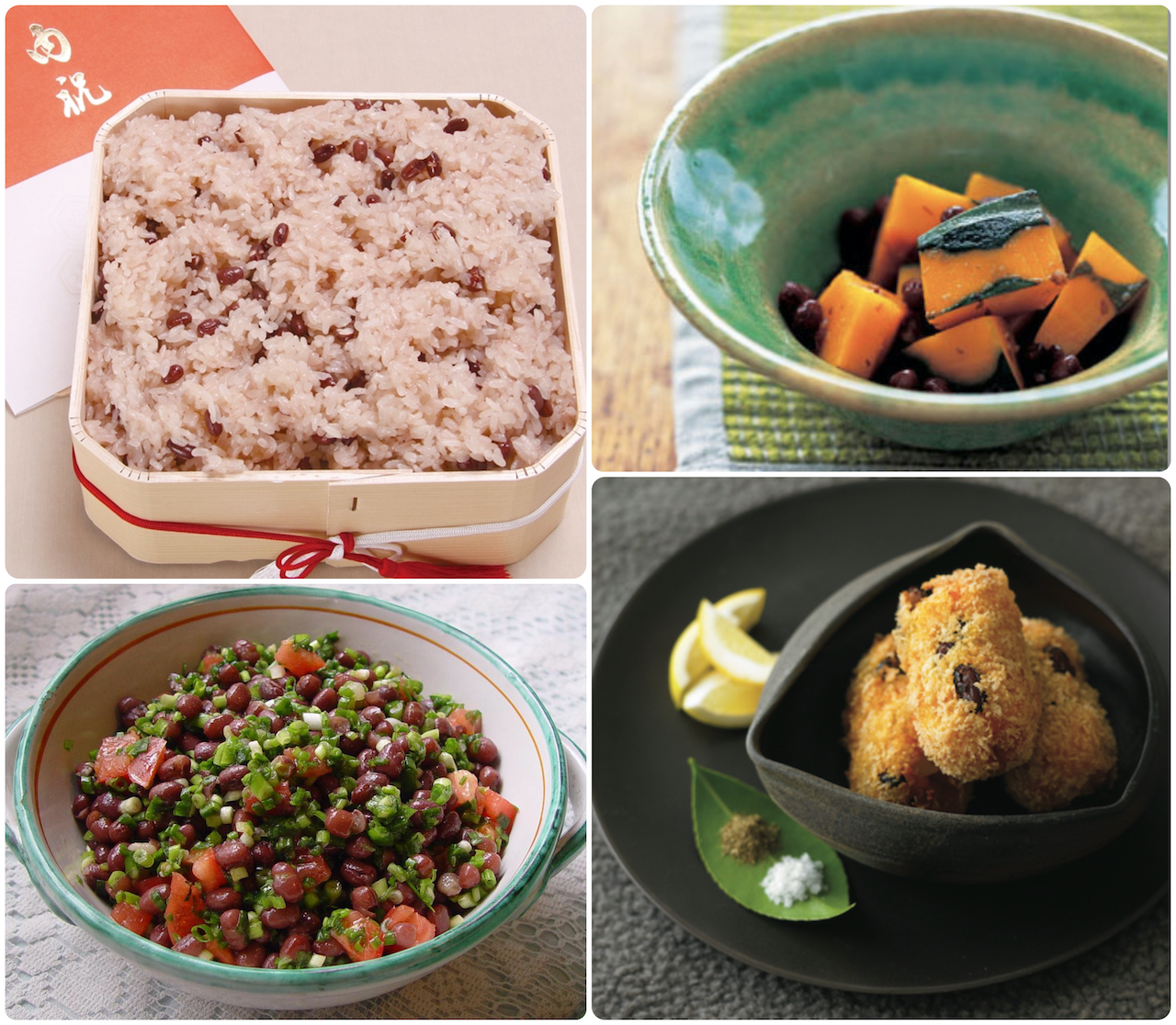
The SAVORY SIDE of ADZUKI

Pictured above from top left, clockwise: SEKIHAN festive red rice with adzuki beans. ITOKO NI kabocha simmered with adzuki beans (recipe pg. 206 WASHOKU), KOROKKE kabocha croquettes with adzuki beans (recipe pg. 118 KANSHA), ADZUKI SALAD with tomatoes and scallions.

Head to the Kitchen Culture page for more about adzuki beans.

My November 2022 NEWSLETTER is about Shichi Go San
celebration of children (girls aged 3 and 7; boys aged 5).
Oysters

Oysters

Throughout the world, oysters have been a popular food source since ancient times. Archeologic evidence in Japan, in the form of kaizuka (shell mounds), dates to the Jōmon period (14,000-300 BCE). Oysters had been abundant for millennia and harvested in their natural...

PROJECT Kagami-Biraki

PROJECT Kagami-Biraki

In most parts of Japan, kagami mochi is on display for several weeks, by which time the omochi rice cakes have dried out and begun to crack. KAGAMI-BIRAKI, the ritual smashing of the dried out omochi, is performed on January 11, this date having been fixed in the 17th...

Kagami Mochi

Kagami Mochi

At New Years’ time, the Japanese decorate their homes with a special display called KAGAMI MOCHI. There are many regional variations on the theme but typically two large rounds of omochi rice taffy are stacked with a daidai 橙 (bitter orange) on top. The arrangement is...

Symbolic Pine

Symbolic Pine

Because pine trees are hardy evergreens, they are a symbol of longevity and resilience in Japanese culture. As such they are a key motif used at New Year’s. Various foods are configured to evoke the image of pine needles (matsuba 松葉 ) and pine cones (matsukasa 松笠 )....

Recent Posts & Projects