Smashed Cukes

Jun 12, 2019 | Kitchen Culture, Year-Round

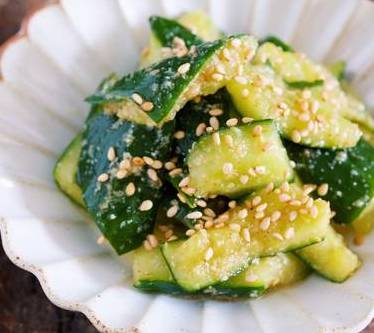
Smashed cucumbers dressed with sesame-soy vinaigrette-style dressing, garnished with toasted sesame seeds.

Smashed Cucumbers with Toasted Sesame

Tataki Kyuuri no Goma Aé

たたき胡瓜の胡麻和え

Most supermarkets in Japan set up a small table at the back of their produce section with slightly bruised or blemished (and therefore deeply-discounted) fruits and vegetables. Here, too, you can find day-old, but still fine-flavored and perfectly safe to consume, items. I am in the habit of regularly scanning the display to see what’s available. Whenever I see less-than-gorgeous-looking, odd-shaped cucumbers I grab them to make this salad.

The cucumbers are especially good when dressed with a Sesame-Soy Vinaigrette-Style Dressing. It’s easy to make in quantity in a glass jar with a tight fitting lid; store the mixture in the refrigerator for up to a week. Shake the jar to distribute well just before pouring out.

DOWNLOAD recipe
Smashed Cucumbers Toasted Sesame

Symbolic Pine

Symbolic Pine

Because pine trees are hardy evergreens, they are a symbol of longevity and resilience in Japanese culture. As such they are a key motif used at New Year’s. Various foods are configured to evoke the image of pine needles (matsuba 松葉 ) and pine cones (matsukasa 松笠 )....

Katsura Muki, gossamer thin peels

Katsura Muki, gossamer thin peels

Daikon radish is peeled into long, seemingly impossibly thin ribbons in a cut known as katsura muki. The skill needed to produce these peels is the most basic requirement in any Japanese professional kitchen. It typically takes months (if not years) of daily practice...

Tsutsumu… wrapping, enveloping

Tsutsumu… wrapping, enveloping

Written with calligraphy for “bath” (furo 風呂) and “spread out” (shiki 敷) the word is rather curious for a piece of cloth. It seems the origins hark back to the Muromachi Period (1336-1573 AD) when Daimyo lords would spread out a cloth in which to wrap their clothing...

Escape the Lingering Heat

Escape the Lingering Heat

The ancient, lunar-based koyomi almanac marks the start of autumn with risshū 立秋. When hot weather continues beyond that time, the phenomenon is referred to as zansho 残暑, literally "lingering heat." On the Gregorian calendar, this year (2025) risshū arrived on August...

Recent Posts & Projects