Rice Porridge with Seven Spring Herbs

Jan 2, 2020 | Culture, Holiday, Kitchen Culture, Spring, Winter | 4 comments

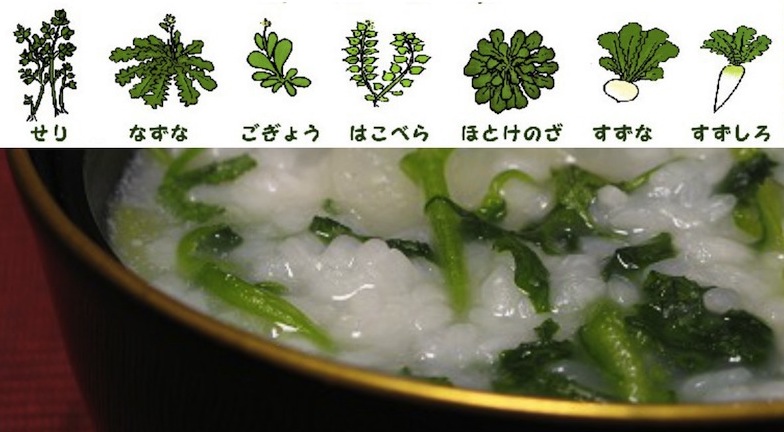
From left to right, the seven spring herbs are: SERI, NAZUNA, GOGYŌ, HAKOBERA, HOTOKÉNOZA, SUZUNA, SUZUSHIRO

七草粥
Nana Kusa Kayu
Rice Porridge with Seven Spring Herbs

More than a thousand years ago, the Japanese spoke of watari-dori (“migrating birds”) coming from the Asian mainland in wintertime bringing with them unwanted viruses – early evidence of avian flu epidemics! Eating nutritious nana (seven) kusa (grasses) kayu (porridge) on the 7th day of the New Year was believed to strengthen resistance to infection and colds.

Indeed the seven “grasses” traditionally cooked into rice porridge are vitamin and mineral rich leafy herbs and flowering greens.

Variations on the theme… Topping bowls of okayu with broiled salmon and/or uméboshi plums are both popular variations on the rice porridge theme. The saltiness of either, or both, eliminates the need for any salt in seasoning the porridge.

Try making your own OKAYU: Download a recipe-guide for Nana Kusa-Gayu

The Language of Learning

The Language of Learning

Although we are all born with some innate capabilities, we also must LEARN in order to survive and thrive. Different cultures manage learning differently. The Japanese language has two verbs that can be used when talking about acquiring information and experience....

Oysters

Oysters

Throughout the world, oysters have been a popular food source since ancient times. Archeologic evidence in Japan, in the form of kaizuka (shell mounds), dates to the Jōmon period (14,000-300 BCE). Oysters had been abundant for millennia and harvested in their natural...

Kagami Mochi

Kagami Mochi

At New Years’ time, the Japanese decorate their homes with a special display called KAGAMI MOCHI. There are many regional variations on the theme but typically two large rounds of omochi rice taffy are stacked with a daidai 橙 (bitter orange) on top. The arrangement is...

Symbolic Pine

Symbolic Pine

Because pine trees are hardy evergreens, they are a symbol of longevity and resilience in Japanese culture. As such they are a key motif used at New Year’s. Various foods are configured to evoke the image of pine needles (matsuba 松葉 ) and pine cones (matsukasa 松笠 )....

Recent Posts & Projects